6 min read
Can a Franchise Replace Your Corporate Income? A Realistic Financial Timeline
Franchise Insider
,
Ray Fanning
,
Terry Coker
:
September 10, 2026
Yes. A franchise can replace your corporate income, and for plenty of former executives it eventually pays more. The part people get wrong is the timing.
Most six-figure earners picture a clean swap. Leave the salary in spring, draw the same money from the business by fall. That version almost never happens, and expecting it is how sharp people run themselves into trouble.
The question that actually matters is whether you can fund the gap until the income arrives. Get that one right and the timeline stops being scary. Get it wrong and even a strong business can sink you before it gains traction.
What Income Replacement Actually Means
Three numbers get mixed together, and confusing them is where realistic franchise income expectations fall apart. People mix break-even, profit, and income replacement into one idea.
Break-even is when the business covers its own costs. Profit is when it earns more than it spends. Income replacement is when that profit, in your pocket, matches what your job used to pay you. They arrive in that order, often months or years apart.
A unit can break even and still put nothing in your bank account. It can turn a profit and still pay you less than your old salary. Income replacement is the last of the three milestones, and it is the one that matters to your family.
A Realistic Break-Even Timeline
Ask how long to profit from a franchise and the honest answer starts with “it depends,” because it does. The ranges are still knowable.
Most franchises reach break-even somewhere between the first six months and the second year. Simple, low-overhead models get there faster. Anything with a build-out, a lease, and a hiring ramp takes longer. A brand’s Item 19 in the Franchise Disclosure Document, where it exists, gives you a starting reference, and current owners give you the truth behind it.
Treat any franchise break even timeline a brand hands you as a claim to verify, not a promise to bank on. The number in the brochure describes the average owner on a good day. Your ramp depends on your market, your capital, and how well you run the place.
From Break-Even to Replacing Your Paycheck

Break-even is the early milestone. Replacing a six-figure salary sits further out.
For most owners, franchise income replacement takes two to four years, and the size of your old paycheck stretches that. Replacing $90,000 is a different climb than replacing $250,000. Some owners pass their corporate number and keep going. Some settle below it and take the trade for control and equity. Some never fully replace the salary and still call the move a win, because the asset they built is worth more to them than the income line.
Anyone who promises you a specific figure by a specific date is selling something. The honest version is a range you pressure-test against real owners in the same model.
The Gap You Have To Fund
Here is the number that actually protects you. It is your runway, the months you can fund before the business pays you.
You already know the three costs everyone plans for: the franchise fee, the build-out, and the equipment. The four that catch people are working capital, the marketing you keep spending, the months of ramp before the business pays you, and the personal income you still need to live on the whole time.
That last one is the quiet killer for executives. Your mortgage, tuition, and lifestyle do not pause while the business finds its feet. Before you sign anything, get clear on what you can invest and, separately, how many months of household expenses you can carry with no help from the business. Those are two different questions, and the second one decides whether the timeline is survivable.
Your Model Decides the Math

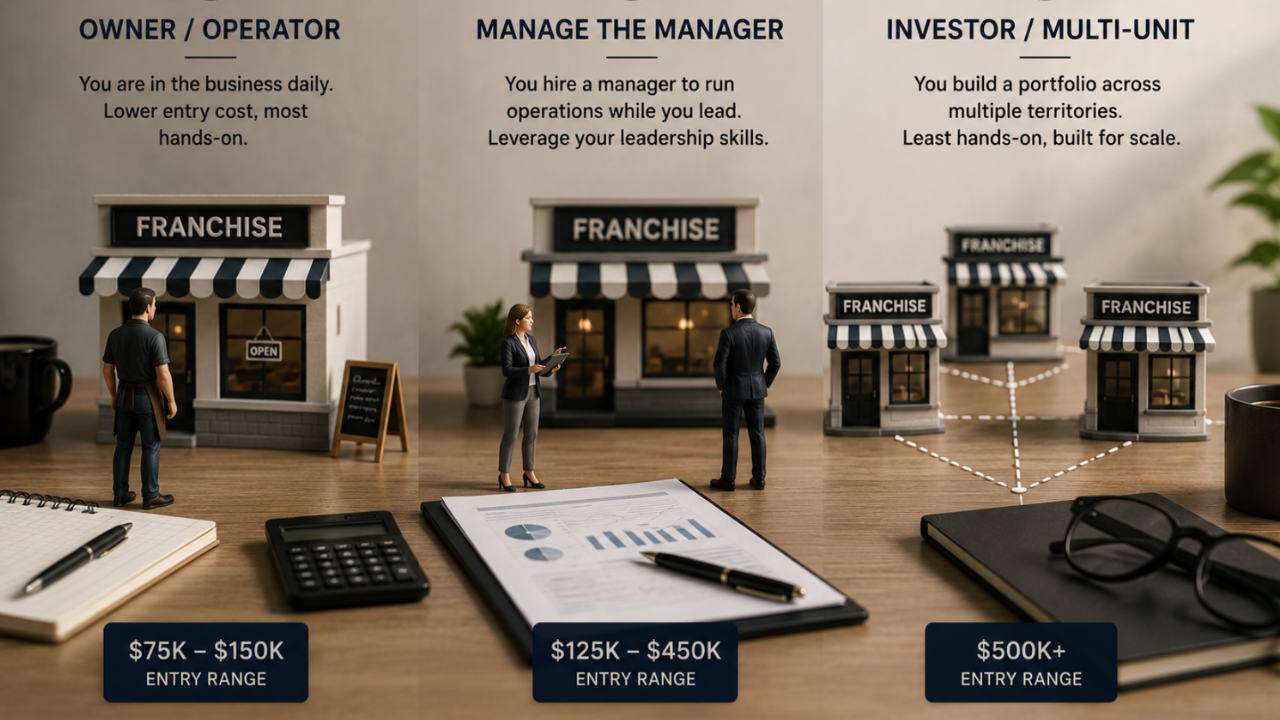
The ownership model you choose bends the timeline more than the brand does. There are three, and they trade speed of income against effort and scale.
Owner-Operator
You work in the business daily. The owner-operator model often draws an owner’s wage soonest, because you are the labor and there is no manager’s salary to cover first. The catch is that you have bought yourself a demanding job, and you can only earn as much as your own hours allow.
Manage the Manager
You hire someone to run daily operations while you lead. The manage-the-manager model usually takes longer to replace your income, because the business has to cover a manager’s pay before it covers yours. It is also where most corporate professionals land, because it uses the leadership skills you already have and it does not trap you behind the counter.
Investor and Multi-Unit
You put capital in and build a portfolio. The investor and multi-unit model is slowest to replace a salary and heaviest on capital, and it aims at something bigger than a paycheck. The executives who build real wealth here are usually after equity and exit value, not a fast income swap.
What Actually Moves the Timeline
Two owners in the same brand can hit income replacement years apart. A few things explain most of the gap:
- Capital and runway. Owners who fund the ramp properly can wait for real profit. Owners who run short take whatever the business offers early, which slows everything down.
- The model and the payroll behind it. Every salary the business pays before it pays you pushes your timeline out.
- Your market. Local demand and competition move ramp speed more than most brochures admit.
- Execution. The system is proven. You still have to run it well, day after day, in your market.
- Whether you scale. A second and third unit change the math entirely, for better and for slower.
None of these show up on a franchise sales page. All of them show up when you talk to owners already doing it.
How To Get a Real Number for Your Situation
Averages are a starting point. Your timeline is personal, and you can estimate it before you risk a dollar.
Read the brand’s Item 19 and Item 7 in the FDD so you know the investment and any income data the franchisor is willing to put on paper. Then call current owners and ask the questions that surface the real ramp: how long until the business paid you, not just until it broke even, and how year one compared to what you were told. Then build a simple model with a conservative case. Most people ask whether they can afford to open. The better question is whether you can sustain the business until it works.
Our whole structured approach is built to answer that question with evidence instead of hope.
A Realistic Way To Decide
A franchise can replace your income. The timeline runs longer than the pitch suggests, the model you choose bends it, and the runway you plan decides whether you reach the other side.
That is the reason Hire Your Best Boss exists. Terry and Ray have spent more than 50 years inside franchising and have guided more than 1,000 corporate professionals through this exact decision. Some moved forward. Some walked away and still call it a win.
Our advice is free to you. Franchisors pay us only if you invest, so we have no reason to push you toward a business, or a timeline, that does not fit your life. We would rather help you plan a realistic runway, or tell you to wait, than watch you run out of cash halfway up the ramp.
One Conversation Could Change Your Next Decade
Apply for a complimentary Corporate Exit Audit and get an honest, personalized assessment of whether business ownership fits your goals, your finances and your life.
FAQs
-
How Long Does It Typically Take for a Franchise To Become Profitable?
Most franchises reach break-even between roughly six months and two years, and true profit follows from there. Low-overhead, service-based models tend to move faster, while anything with a lease, a build-out, and staff to hire takes longer. The brand’s Item 19 in the FDD gives you a reference point where it exists, but the reliable number comes from current owners in the same model and market. Treat any single figure as an average to verify, not a date to count on.
-
What’s a Realistic Timeline for Replacing My Six-Figure Corporate Salary?
Plan on two to four years for most models, and expect the size of your salary to stretch that. Replacing $90,000 is a faster climb than replacing $250,000, because the business has to throw off that much more before it matches your old paycheck. Some owners pass their corporate income and keep climbing, and others settle a little below it and take the trade for control and equity. The realistic move is to model a conservative case and confirm it against owners who started where you are.
-
Should I Expect To Take a Pay Cut in My First Year of Franchise Ownership?
For most people, yes. The first year usually pays you less than your corporate role did, sometimes much less, because early cash goes back into working capital and growth before it reaches your pocket. That is normal and survivable if you planned for it, and dangerous if you did not. This is exactly why your personal runway, the months of household expenses you can cover without the business, matters more than the headline investment.
-
What Percentage of Franchise Owners Achieve Their Income Goals?
There is no definite overall percentage and anyone who says one is guessing or is selling. It’s too unique to be boiled down to a number; the outcome depends on brand, model, market, owner, etc. The owners who achieve their income targets consistently were the ones that had realistic expectations, sufficient funds for their ramp and had selected a model appropriate to their lifestyle. Those who didn't: rushed their decision or underestimated the runway.
-
How Much Should I Budget To Live On While My Franchise Ramps Up?
Budget your full household expenses for the entire ramp, not just the opening costs. A common approach holds twelve to twenty-four months of personal living expenses in reserve, separate from the working capital the business needs, though the right figure depends on your model’s ramp and your household. The question to answer is simple: if the business pays you nothing for a year or more, can your family keep going comfortably? If the answer is no, build a bigger reserve or rethink the timeline before you sign.
-
What Factors Affect How Quickly a Franchise Reaches Profitability?
Several, and the brand is only one of them. Your capital and runway decide whether you can wait for real profit or have to grab early cash. Your ownership model sets how many salaries the business pays before it pays you. Your market shapes how fast demand ramps. Your own execution, running a proven system well every day, does the rest. Two owners in the same franchise can reach profitability years apart, which is why validation with real owners beats any average on a sales page.
%20(52).jpg?width=1280&height=720&name=HYBB%20=%20WEb%20Banners%20(horizontal)%20(52).jpg)

%20(53).jpg?width=1280&height=720&name=HYBB%20=%20WEb%20Banners%20(horizontal)%20(53).jpg)
%20(54).jpg?width=1280&height=720&name=HYBB%20=%20WEb%20Banners%20(horizontal)%20(54).jpg)
%20(55).jpg?width=1280&height=720&name=HYBB%20=%20WEb%20Banners%20(horizontal)%20(55).jpg)
%20(56).jpg?width=1280&height=720&name=HYBB%20=%20WEb%20Banners%20(horizontal)%20(56).jpg)